Recently, the research paper titled Pyramid-Angular-Constraint Network for Light Field Super-Resolution by the team from Data Science and Intelligent Computing Laboratory (DSICLab) at Hangzhou International Innovation Institute of Beihang University (H3I) has been formally published in the internationally top-tier journal Computational Visual Media (CVMJ). This marks a milestone breakthrough by the team in structured modeling and robust semantic understanding of light fields in global scenarios.
The first author of the paper is Yang Da, a postdoctoral fellow at H3I, and the corresponding author is Professor Sheng Hao from the School of Computer Science and Engineering of Beihang University and DSICLab of H3I.
Original Article Link: https://ieeexplore.ieee.org/document/11363133
Computational Visual Media (CVMJ) was founded in 2015 by the Visual Media Research Center of Tsinghua University. Its Editor-in-Chief is Professor Hu Shimin, academician of the Chinese Academy of Sciences and faculty of Tsinghua University, and the Associate Editors are Professor Ralph Martin from Cardiff University, UK, and Professor Ming C. Lin from the University of Maryland, USA. At present, CVMJ is indexed in more than 20 databases, including SCIE, EI, DBLP, and Scopus.
CVMJ obtained its first SCI impact factor of 4.127 on June 28, 2022. On June 18, 2025, its impact factor rose to 18.3, ranking 1st in SCI Q1 under the category of Computer Science – Software Engineering. According to Scopus, CVMJ has a CiteScore of 28.5, also ranking 1st among journals in computer graphics and computer-aided design.
Light field cameras can record both the intensity and propagation direction of light rays in a scene in a single exposure. However, due to the trade-off between spatial and angular dimensions, the spatial resolution of light field images is limited. Therefore, super-resolution has become a key step in light field image processing. Pixels in light field images follow a linear coordinate mapping relationship among Sub-aperture Images (SAIs). Thus, when performing super-resolution on any target SAI of a light field, the effectiveness of supplementary information extracted from auxiliary SAIs gradually decreases as the angular distance between auxiliary SAIs and the target SAI increases. Based on the angular-distance constraint, the team proposed a novel light field image organization structure—the Light Field Pyramid (LF-pyramid), which groups and utilizes auxiliary SAIs according to their effectiveness in the target SAI super-resolution task, thereby significantly reducing the difficulty of extracting effective supplementary information and improving super-resolution performance. Accordingly, the team further proposed the Pyramid-Angular-Constraint Network (LF-PACNet) for light field super-resolution, which efficiently extracts complementary features with differentiated effectiveness based on the view image hierarchy of the LF-pyramid.
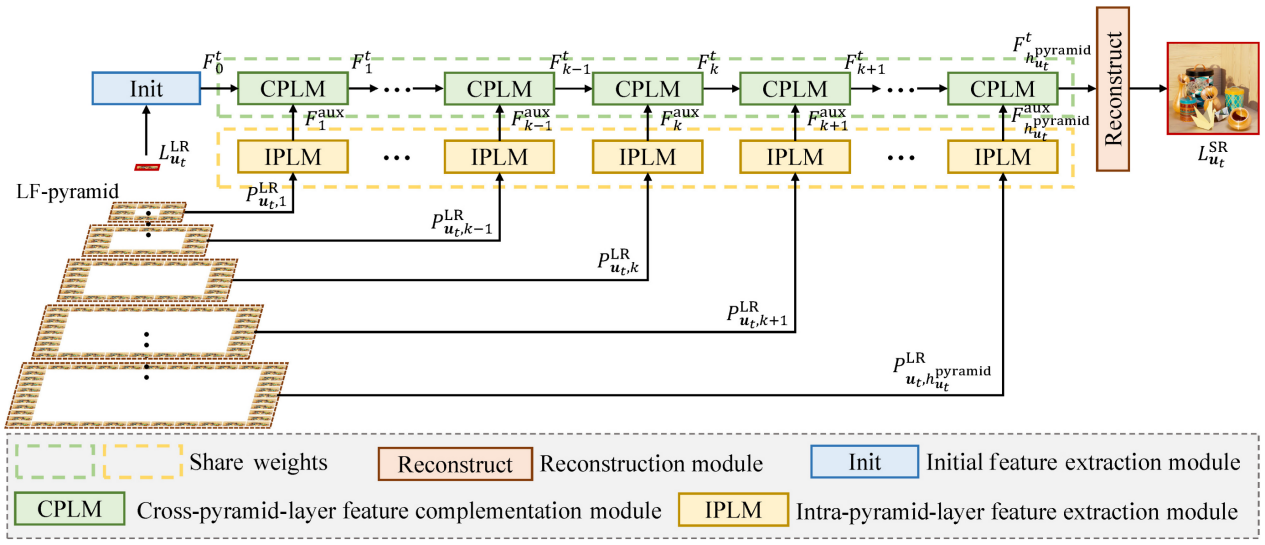
△ LF-PACNet Network Structure Diagram
Specifically, to address the problem of a variable number of views per layer, an intra-pyramid-layer feature extraction module is designed, which treats views with similar effectiveness equally during complementary information extraction. To tackle the problem of a variable number of layers, a recurrent cross-pyramid-layer feature complementation module is constructed to discriminatively supplement high-frequency details for the target view. Extensive experimental results on public datasets demonstrate that this method significantly outperforms other methods in both visual effects and numerical metrics, with particularly outstanding performance on challenging datasets with large disparities.
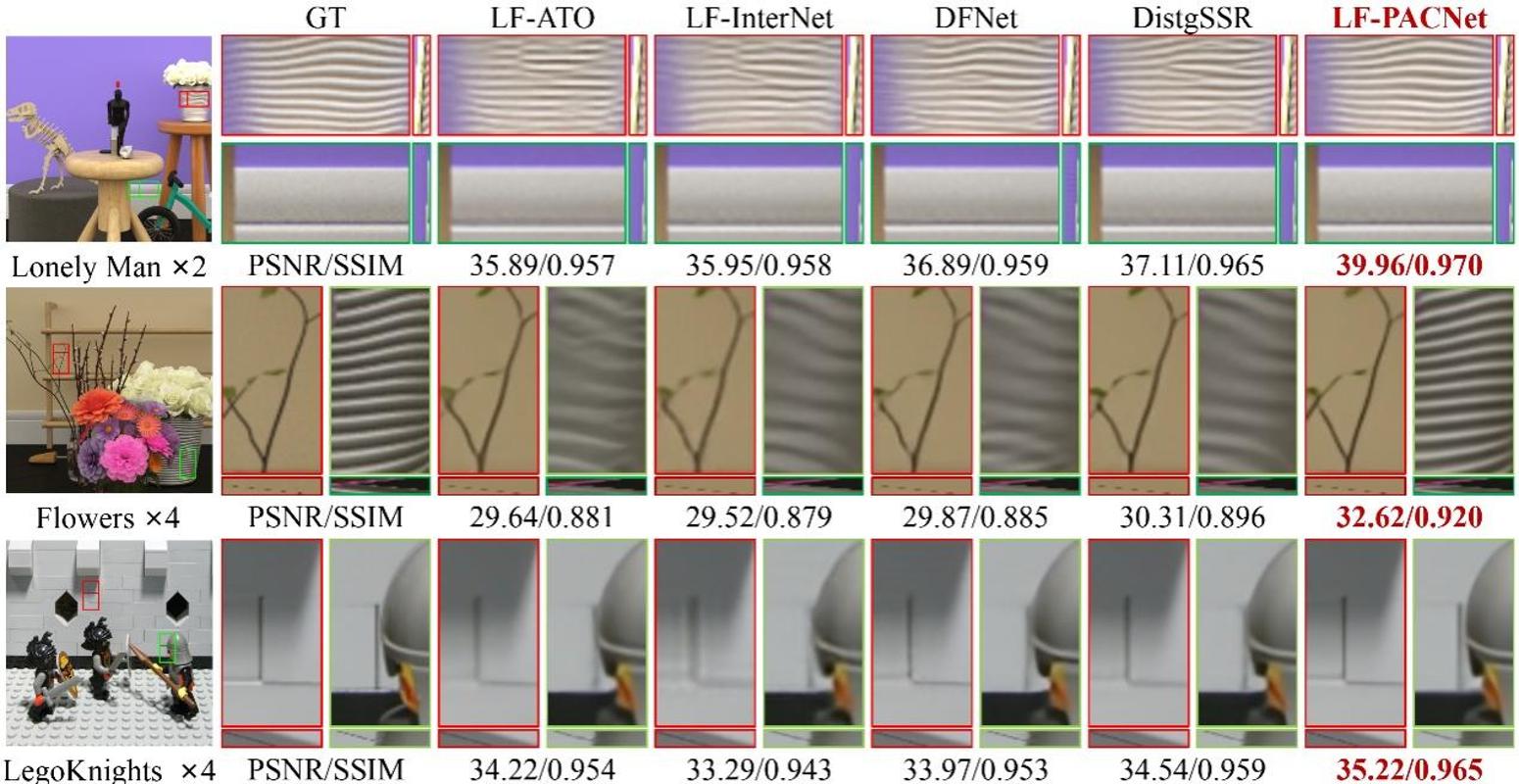
△ Comparison with Other Methods
DSICLab
DSICLab at H3I conducts teaching and research focusing on IoT perception, data science, intelligent computing, information security, and other fields, cultivating New Engineering professionals in the era of artificial intelligence. The platform is mainly responsible for the R&D, construction, and operation of XHang, Beihang University's own AI infrastructure, as well as the R&D, construction, and operation of Beihang's intelligent computing power platform.
The DSICLab has long been engaged in research on visual understanding, light field imaging, and AI-enabled healthcare, with relevant technologies applied in the West Lake Scenic Area, key hospitals, and other sites. The team first proposed the global light field theory, and has published more than 60 papers in top journals/conferences such as TPAMI, TIP, CVPR and ICCV in light field image processing (including 10 highly cited papers and 4 hot papers); it published Light Field Image Processing, the first domestic textbook in this field; it has applied for/granted more than 20 patents, with relevant patents implemented in the West Lake Scenic Area and other locations; it proposed UrbanLF, the first large-scale light field semantic segmentation dataset, which is the official dataset for the depth estimation and semantic segmentation challenges at the 3rd International Light Field Workshop LFNAT 2023 CVPR Workshop, and is currently the only recognized benchmark dataset in light field image semantic segmentation; a series of methods proposed by the team have long ranked among the top in the general benchmark for light field depth estimation and won the championship at the CVPR International Challenge on Light Field Semantic Segmentation; its research achievements have been reported by mainstream media including Xinhua News Agency, People's Daily and People.cn.
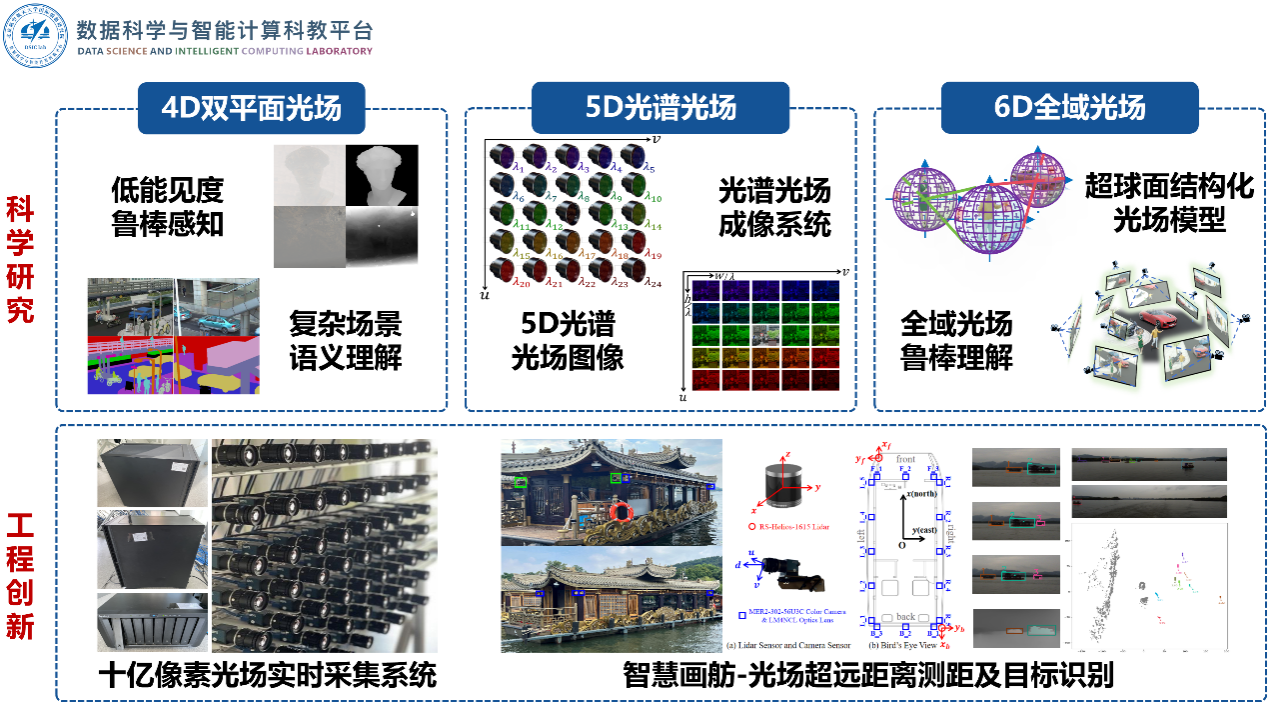
Approved by Dong Zhuoning, Zhang Wei, Xu Ran
Edited by Yuan Xiaohui